Icons of Black History in the Neighborhood
Icons of Black History in the Neighborhood
Written by Rev. Dr. Clarence E. Wright
I know what you’re thinking, what does Mr. Rogers have to do with Black History? Turns out, quite a lot. The purpose of this article is not to center Fred Rogers (a white man) in Black history month, but rather to highlight some of the many Black Americans who influenced him, and the significant impact Fred Rogers had on racial reconciliation and repair. So, here are four stories about four influential Black Americans in the life of Fred Rogers.
George Allen (Mr. Rogers’ “Black Brother”)
It is a little-known fact that in addition to being a beloved television host, Fred Rogers was also a pilot. Even lesser-known fact is that he was taught how to fly by his “Black brother.” That’s right, Mr. Rogers had a Black brother. Let me explain… When Fred Rogers was three years old, a young man named George Allen who was himself just an early teenager came to live with the Rogers family after his own mother had died. George Allen would turn out to be a major role model for young Fred and he was highly accomplished in his own right.
Allen was already interested in flying but after moving in with the Rogers family he took lessons at the airport in Latrobe, PA. To earn money for flying lessons, he played drums five or six days a week with local dance bands, and worked as a chauffeur for Mr. Rogers’ father, James H. Rogers. After he had made his first solo flight, he sold his car to buy his own plane that he repaired with help from some aviation mechanics.
In 1941, Allen went to the Tuskegee Institute as one of three Black instructors of pilot cadets. Their students ultimately became the core of the 99th Pursuit Squadron and other fighter groups, the first black pilots ever to fly for the U.S. military. That’s right, George Allen, the young Black man who lived with Fred Rogers was an instructor of the famous Tuskegee Airmen, the Black pilots who helped win World War II. After the war when Fred Rogers was in high school, Allen returned to Latrobe and taught young Fred Rogers how to fly. Throughout his life, Rogers highly admired George Allen and referred to him as his “Black brother” when he was a guest on the Arsenio Hall Show. George Allen is a reminder of the rich history of African Americans in aviation and service to the nation.
Francois Scarborough Clemmons (Officer Clemmons)
Another little-known fact is that Fred Rogers was physically color blind, unable to distinguish between red and green. However, while he could not distinguish color with his natural eyes, he was keenly aware of color from a sociological standpoint. He didn’t fall into the trap of a “color blindness” that did not see race, instead, he appreciated the uniqueness of all races and creeds, and he intentionally centered characters in Mister Rogers’ Neighborhood who were Black, Women, Asian, Disabled and several other intersectional identities. None exemplify this ideology of inclusion more than Francois Scarborough Clemmons.
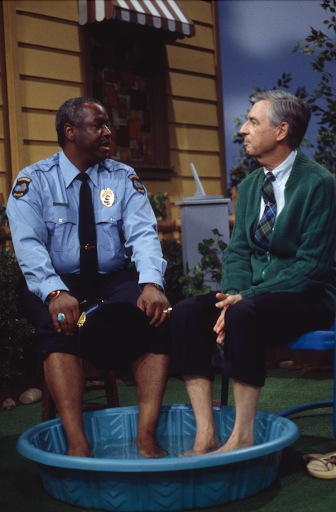 Francois Clemmons became the first Black actor to have a recurring role on a children’s television program when he joined Mister Rogers’ Neighborhood in 1968 as Officer Clemmons, the singing police officer. His mere presence on the show was groundbreaking, but one episode in 1969 was particularly impactful. At the height of the debate over Jim Crow segregation, Officer Clemmons and Mister Rogers shared a wading pool. This seems benign today, but in 1969 the stark contrast of Fred Rogers’ white feet and Francois Clemmons’ black feet in the same pool was a profound response to incidents of racism at swimming pools in the 1960s.
One of the most infamous events occurred in 1964 in St. Augustine, Florida, when Black and White protesters staged a “swim-in” to protest segregation at a whites-only motel. In response the motel manager threw acid into the pool while the swimmers were still inside. A mere 5 years later with continued unrest, and in the wake of riots and incidents of police brutality, Fred Rogers visioned this simple scene sharing a pool with Clemmons portraying a Black Police officer. By sharing a wading pool with Clemmons, and drying Clemmons’ feet with a towel, Rogers sent a subtle but strong message of equality to young viewers. It was also a theological message, from Rogers who was an ordained Presbyterian minister. Rogers wiping Clemmons’ feet with a towel symbolized Jesus washing the disciples’ feet on the night of the last supper.
Francois Clemmons would stay with the program for 24 years, and in his final episode in 1993 the two would reprise the pool scene. The second time was equally timely, happening in the wake of the Rodney King beating and riots in South Central Los Angeles. Once again, the image of a Black Police officer sharing a wading pool was a timely and profound statement. Both during and after the program, Francois Clemmons maintained a distinguished career as an opera singer, winning a Grammy Award as part of the Cleveland Orchestra’s recording of Porgy and Bess. He went on to form the Harlem Spiritual Ensemble and served as an artist-in-residence at Middlebury College in Vermont where he still lives today.
Maggie Stewart (Mayor Maggie of Westwood)
Sharon Pratt Dixon made history as the first Black woman to lead a major American city when she was elected mayor of Washington, D.C. in 1990, but 15 years prior there was already a Black woman mayor on Mister Rogers’ Neighborhood, Mayor Maggie of Westwood. Maggie Stewart first appeared on Mister Rogers’ Neighborhood in 1975 and continued as a valuable member of the cast until the program ended in 2001. In the “Neighborhood of Make-Believe,” Stewart portrayed Mayor Maggie, the mayor of the neighboring town of Westwood, and appeared as herself, Maggie Stewart, in the “real” television neighborhood. Maggie’s appearance as a Black woman mayor in 1975 was not at all an accident, it was one of many examples of Fred Rogers intentionally creating characters that challenge discriminatory societal norms. In this case Fred Rogers specifically wanted to showcase a Black woman in a leadership position, and that position was Mayor.
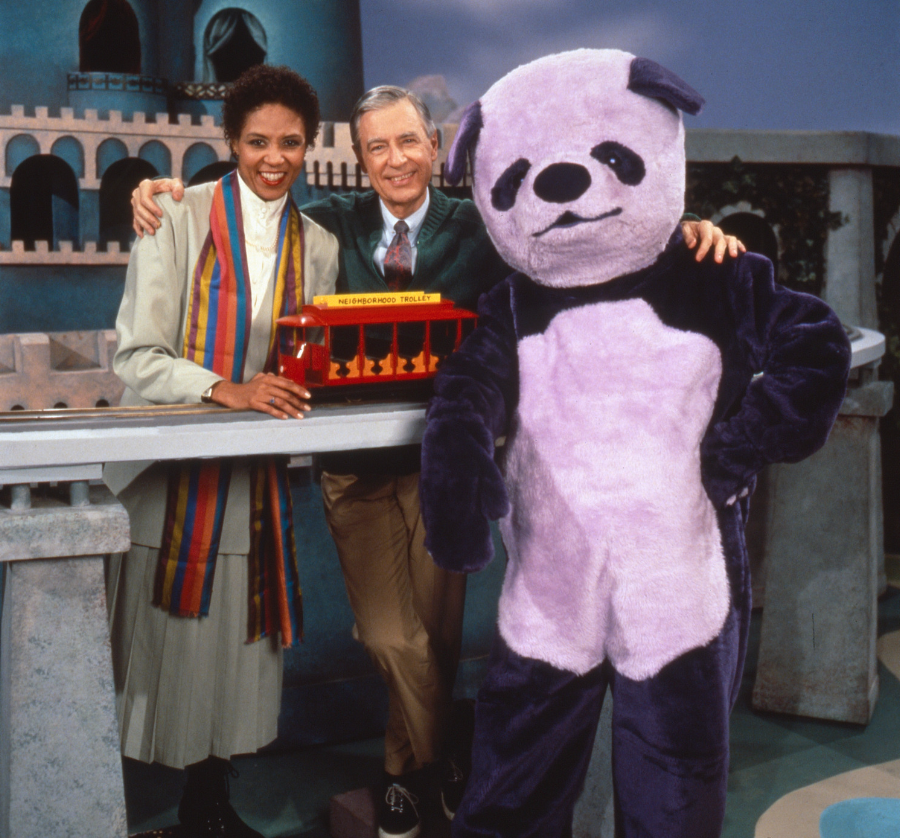 In the real world there weren’t many examples of women mayors, especially Black women mayors in 1975. Doris A. Davis who was (elected mayor of Compton, CA in 1973) was a notable exception, but beyond her there were precious few examples of women in executive political leadership in 1975. In fact, women had only gained the right to obtain credit cards or loans in their own name without a male co-signer in 1974 the year prior. Maggie Stewart featured as a mayor on a popular children’s television program normalized a Black woman as a political leader for an entire generation. That generation would go on to elect many more women to political office, including more than a dozen Black women who have served as mayors of major U.S. cities.
Fluent in sign language, Stewart frequently incorporated signing into her musical performances, teaching Mister Rogers and the audience signs for everyday words. In this way she was not only an example for Black women in leadership, but a shining example of accessibility for the hearing impaired. In addition to her work on Mister Rogers’ Neighborhood, Stewart has numerous acting credits and has worked as a professional sign language interpreter. Her contributions in Mister Rogers’ Neighborhood have unquestionably left a tangible legacy in the real world.
Bill Strickland (Manchester Bidwell Corporation)
Bill Strickland is a community leader, author, and former President and CEO of the Manchester Bidwell Corporation, a Pittsburgh nonprofit renowned for its innovative approach to arts education and workforce development. Learning pottery in high school sparked a passion that would lead to half a century of mentoring youth through the arts and job training for displaced adults. Strickland’s work earned him the MacArthur “Genius Grant” Fellowship among many other awards, and he was also featured in two significant episodes of Mister Rogers’ Neighborhood.
He first appeared on Mister Rogers’ Neighborhood, in 1973 where he demonstrated his pottery-making skills to Mr. Rogers and the audience. This episode highlighted the importance of the arts for personal development and community building. It was also significant for children in 1973 to see a Black man presented as an expert and an educator. Strickland returned to the program 18 years later in 1991.
In his first appearance in 1973 Bill Strickland showed his own pottery skills. In his second appearance in 1991 Mr. Rogers took to the wheel with Strickland guiding his hands as a patient teacher. The image of Strickland standing over Roger has become an iconic depiction of Strickland’s life as an educator. The 1991 episode also explicitly connects the arts with positive expression of feelings. Mister Rogers even reprises a verse of “What Do You Do with the Mad that You Feel?” the classic song he wrote in 1968 about anger management which includes the line “Do you pound some clay or some dough?” Whether simple play dough or ceramic pottery with Bill Strickland, the point is not the clay, but providing an outlet to express complex emotions.
After five decades of leadership, Strickland retired as CEO of Manchester Bidwell Corporation in 2018, but retirement has not slowed him down. He has since launched the Strickland Global Leadership Institute. Through SGLI there are now 17 centers like the original in Pittsburgh with vocational and youth arts training, including three overseas. One of the locations is located in Israel where Jews and Palestinians are taking classes together. His enduring commitment to arts education continues to build bridges worldwide.
Why This Matters
Fred Rogers not only exemplified the importance of respect and admiration for neighbors of all stripes; in the process he modeled reconciliation and repair. Mister Rogers’ Neighborhood was not just a children’s television program, it was a demonstration of a reparative theology. The applied theology of Mister Rogers’ Neighborhood offers an unexpected but deeply instructive framework for individuals and organizations to engage in the necessary work of reconciliation and repair. Fred Rogers quietly modeled what that can look like by curating a neighborhood that was named after him, but centered on and celebrated those of a variety of backgrounds and cultures.
*Photos from Fred Rogers Productions.
Support Us
Your financial support of the Institute helps us expand our initiatives and resources so that educators and children's helpers can continue to learn and grow from Fred Rogers' legacy. Thank you!