Icons of Women's History in the Neighborhood
Icons of Women’s History in the Neighborhood
Written by Rev. Dr. Clarence E. Wright
March is Women’s History Month, which gives an opportunity to highlight a few of the many women who impacted the life of Fred Rogers both on and off the Mister Rogers’ Neighborhood television program. The purpose of this article is not to center Fred Rogers during a month devoted to Women’s history, but rather to highlight some of the many women who influenced him, and contributed to the legacy of his work in children’s television. So, here are seven stories about influential women in the life of Fred Rogers.
Dr. Margaret McFarland
Mister Rogers’ Neighborhood was never meant to be entertainment. To this day those involved in production of the television program shun use of the word “show.” Throughout its run Mister Rogers’ Neighborhood was designed for early childhood development and education, rooted equally in both faith and science. The faith was rooted in Fred Rogers’ Presbyterian upbringing and his education at Pittsburgh Seminary, but the science was a direct reflection of his mentor and advisor of more than 20 years, Dr. Margaret Beall McFarland.
The youngest of 3 girls, Margaret McFarland was born in 1905 in Oakdale, PA, a suburb of Pittsburgh. Her father died when she was 5, which would later pique her interest in child psychology. She would ultimately pursue a career as a child psychologist earning a master’s degree and Ph.D. in psychology from the Teachers College at Columbia University. She became known for her influential work in early childhood development and ultimately for her collaboration with Fred Rogers on Mister Rogers’ Neighborhood.
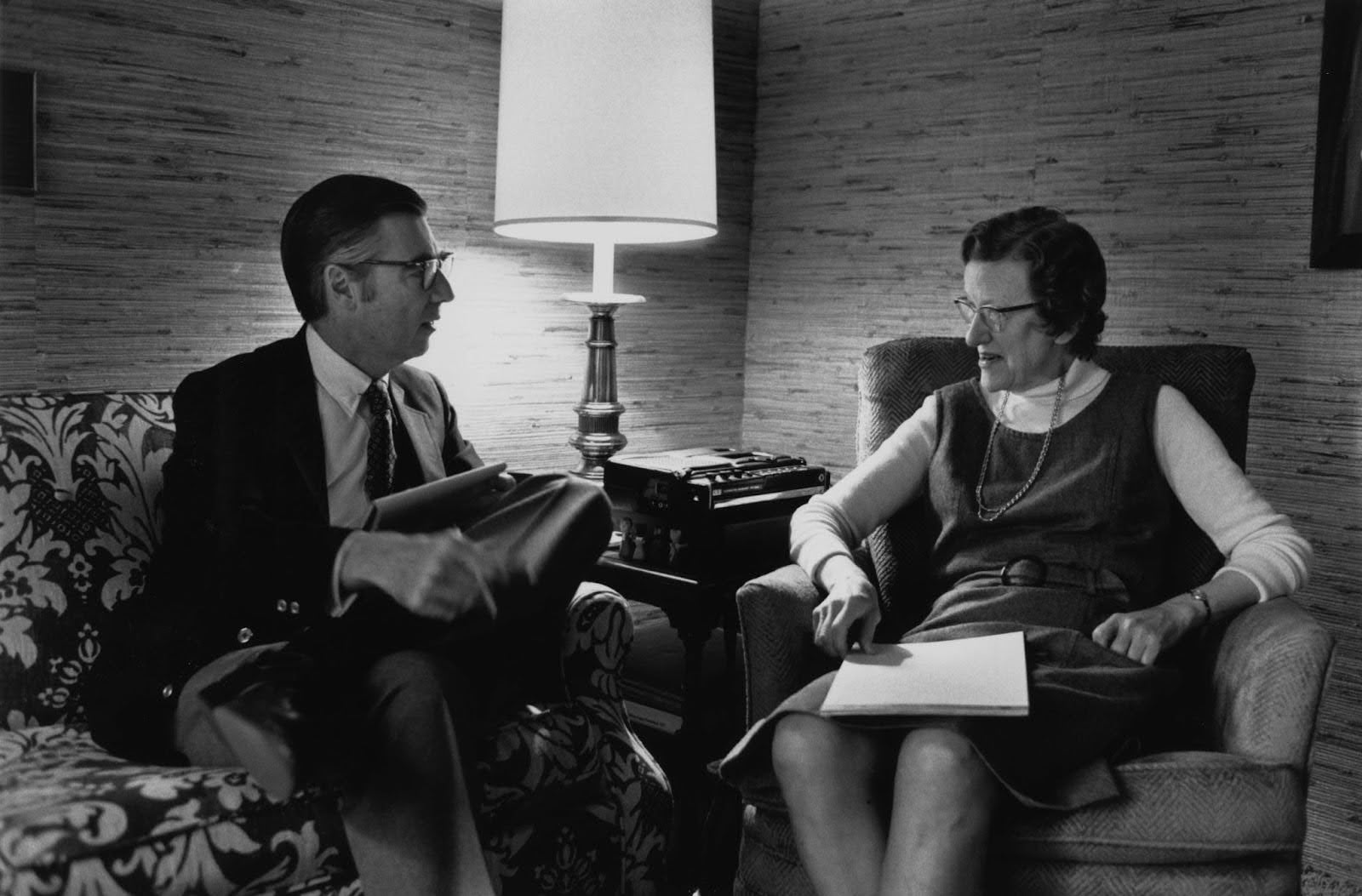
Rogers met Dr. McFarland when he attended graduate classes in child development at the University of Pittsburgh in the early 1960s. She served as a professor in the Department of Psychiatry at the Pitt School of Medicine, and as the Director of the Arsenal Family and Children’s Center in Pittsburgh, which she co-founded with notable pediatrician Benjamin Spock and psychoanalyst Erik Erikson. It was McFarland who encouraged Rogers to move from behind the camera to in front of the camera. When he was content working as a behind the scenes producer, she told him “Fred, the children need to see you. They need you to help them distinguish between reality and fantasy.” After he followed her advice, she would continue to be a trusted advisor and integral part of Mister Rogers’ Neighborhood.
Though she never appeared on camera, McFarland and Rogers met weekly to discuss themes, scripts, and songs that Rogers had written. At times, if Rogers had a question about how an aspect of the program would affect children, he would pause taping to go and seek advice from McFarland whose office was not far from the studio at WQED. The thoughtful and compassionate way Mister Rogers’ Neighborhood addressed complex feelings and emotions in children was largely due to the influence of Margaret McFarland. She continued as Fred Rogers’ mentor and advisor from the start of the program in 1968 until her death in 1988.
Hedda Sharapan
You may not recognize Hedda Sharapan as an on-screen neighbor, but she remains today one of the strongest connections to the legacy of Fred Rogers.
At the urging of Fred Rogers, Hedda Sharapan pursued her passion for child development by earning a master’s degree from the University of Pittsburgh. This laid the foundation for her lifelong commitment to understanding and nurturing children’s emotional and cognitive growth. Building on her studies in Child Development at Pitt, she served for the entire run of Mister Rogers’ Neighborhood from its first taping in October of 1966 to its conclusion in 2001. Her time with the program included roles as Assistant Director, Assistant Producer, Associate Producer, and Director of Early Childhood Initiatives for Fred Rogers’ non-profit production company. Part of Hedda’s work over the years included reading all the viewer mail and ensuring that each letter got a personal response from Mister Rogers himself. While much of her work was behind the scenes, she did appear on camera in several episodes, notably in 1971 and 1972 as herself along with her daughter Amy who was an infant at the time. She was also the puppeteer for Mrs. Frog.
She continues the legacy of Fred Rogers today as a Child Development consultant for Fred Rogers Productions, which includes work as a script consultant for the award-winning PBS children’s series Daniel Tiger’s Neighborhood among other projects. She was a Senior Fellow at The Fred Rogers Institute at Saint Vincent College for many years and remains an advisor and regular contributor to the Institute’s newsletter. She’s also a regular speaker, presenting professional development for teachers and audiences of all ages, helping them reflect on the timeless messages Mister Rogers’ Neighborhood.
Hedda has rightfully received numerous awards for her continued work in child development. At the 2010 NAEYC (National Association for the Education of Young Children) conference, she was named one of two Heroes on the Horizon, and at the 2011 NAFCC (National Association for Family Child Care) conference she was honored with a Lifetime Achievement award. In 2013 she was awarded an honorary doctorate from Saint Vincent College, home of the Fred Rogers Institute, and was inducted into the Gold Circle of the National Academy of Television Arts and Sciences for her contribution to children’s television for over fifty years. Her work has had a profound impact on the field of early childhood education. Her ability to blend academic insight with practical advice has helped countless parents, educators, and caregivers support children’s healthy emotional development.
Ella Jenkins
Ella Jenkins was an American folk musician, singer, and songwriter, often called the First Lady of Children’s Music. Born in St. Louis and raised in Chicago, her career spanned over six decades with an impressive catalogue of songs that engaged young audiences through call-and-response, rhythmic chants, and influences from gospel, blues and folk traditions. She appeared on eight episodes of Mister Rogers’ Neighborhood from 1974 to 1992 where she shared her music and lessons with the television neighbors.
Though she had no formal music training she was gifted to use the sounds of everyday life like playground clapping games, high school sports chants, and the calls of a sidewalk vendor selling watermelon. With simple instruments like a kazoo, a harmonica, a variety of hand drums, or a ukulele, she used music to teach respect and cross-cultural appreciation. This led to a long career with dozens of albums, including the 1966 release, You’ll Sing a Song and I’ll Sing a Song, which remains one of the best-selling children’s albums of all time.
Her work emphasized inclusivity, cultural appreciation, and music as a tool for education. These shared ideals made her a perfect addition to Mister Rogers’ Neighborhood. Like many involved in the Neighborhood, Jenkins’ influence on children was not accidental, but the deliberate result of careful planning and preparation. She earned a degree in sociology with a minor in child psychology from San Francisco State University, and her interactive approach to engaging young learners through music helped to shape early childhood education in the second half of the 20th century.
Throughout her career, Jenkins received numerous accolades, including a Grammy Lifetime Achievement Award in 2004. She also received two additional Grammy nominations in 2000 and 2005. Ironically, she lost the 2005 Grammy to a tribute album of her own work! Ella Jenkins lived a long and impactful life, continuing to make albums until 2017. She passed away in November of 2024 at the ripe age of 100.
Joanne Rogers
They say behind every good man is a great woman, and Fred Rogers is no exception. No look at MisterRogers’ connection to women’s history would be complete without a look at the love of his life and wife of more than 50 years. Joanne Rogers (born Sara Joanne Byrd) was born on March 9, 1928, (just 11 days before her future husband) in Jacksonville, Florida. Like Fred, Joanne was an accomplished musician, and it was this shared talent and interest in music that would bring the two together. After showing exceptional talent early in life she earned a scholarship to Rollins College in Winter Park, Florida where she earned a bachelor’s degree in piano performance. It was there at Rollins where she met Fred Rogers, a fellow student who had transferred from Dartmouth. Their friendship and shared love for music blossomed into a romance, and they married in 1952.
After graduating from Rollins College, Joanne continued her musical training, earning a master’s degree at Florida State University, and she ultimately became an accomplished concert pianist. She performed both solo and as part of a duo-piano team with her college friend Jeannine Morrison. The pair recorded two albums, Duo-Piano Favorites and A Virtuoso Duo-Piano Showcase., and for more than 40 years they gave recitals across the country. She also taught at the Chatham College preparatory school of music in the 1950’s, and at Carlow College in the 1970’s.
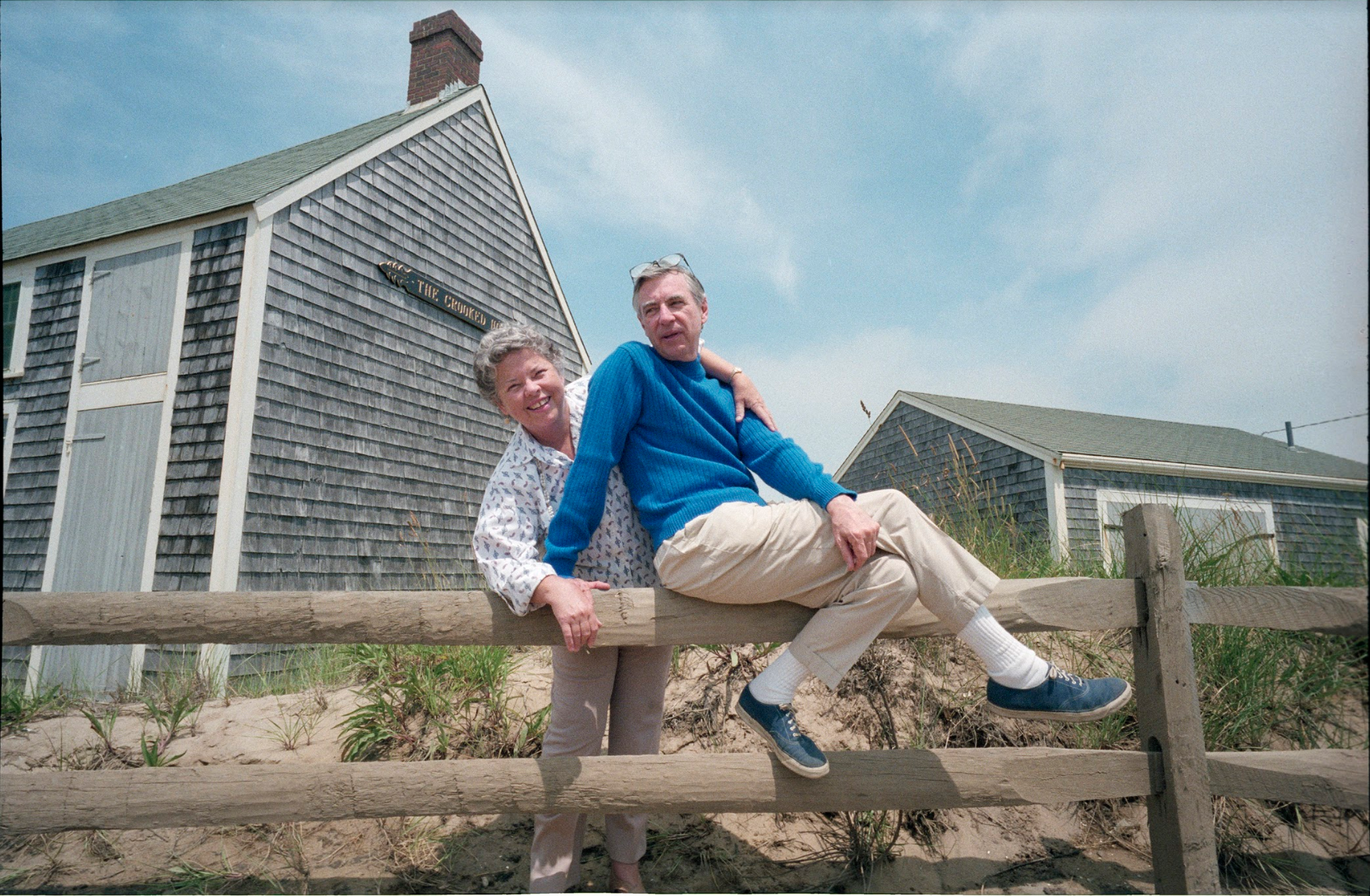 Joanne Rogers was content supporting Mister Rogers behind the scenes while pursuing her own career in music, but she did appear in four episodes of Mister Rogers’ Neighborhood in 1971 and 1975 as herself. And in a case of art imitating life, she was the inspiration for the puppet character Queen Sara, wife of King Friday XIII. After her husband passed away in 2003, Joanne became an advocate for his legacy, often speaking publicly about his work and continuing his mission of kindness and education. She appeared in documentaries and gave interviews and Ted Talks about life with the real Mr. Rogers. She was known for her warmth, humor, talent and intelligence, embodying the same values that made her husband beloved. Joanne Rogers passed away in 2021, at the age of 92.
A Few Others of Note
Yoshi Ito
Yoshi Ito played a talented opera singer who also served as the royal pilot for King Friday XIII in the Neighborhood of Make-Believe. She appeared in 22 episodes of Mister Rogers’ Neighborhood from 1971 to 1975 and had roles in three of the Neighborhood operas playing a Badminton Player in the Snow People, a Pilot in Potato Bugs and Cows and a Handball-Football Player in All in the Laundry. Her character consistently demonstrated kindness, encouraging her friends in the Neighborhood Make-Believe when they had doubts or fears. Yoshi Ito’s singing talent was apparent, but as a Japanese American woman featured as a pilot in 1971 her role was groundbreaking and an inspiration to all who watched.
Elsie Neal
Elsie Neal appeared in 34 episodes of Mister Rogers’ Neighborhood from 1972 to 1975 playing the owner and operator of the Neighborhood craft and costume shop. She gave demonstrations of her own kid-friendly craft projects like making a hat from a paper bag, or flowers from foam. She also provided costumes for use throughout the Neighborhood, and her shop served as the launch pad to showcase special guests who displayed various craft talents. As the owner of her own shop Elsie Neal represented a powerful image of a Black female entrepreneur in the early 1970s when women were more often portrayed in support roles. Her daughter Debbie Neal also appeared in 24 episodes sharing her singing talent while assisting at Joe Negri’s Music Shop.
Dr. Marilyn Barnett
Dr. Marilyn Barnett was a real-life physical education teacher, school administrator and education consultant in the Pittsburgh area for over 40 years. She appeared in 29 episodes of Mister Rogers’ Neighborhood from 1972 to 1999, often stopping by Mister Rogers’ yard to teach simple exercises to him and the television viewers. Her role was vitally important to emphasize the importance of exercise and physical health to the young viewers. But in later years, Marilyn became the principal of an Elementary School in the Neighborhood, which not only showed a Black woman leading, but critically it showed her advancing in her career. Characters in the Neighborhood rarely ended where they began, but rather showed growth and mobility as an example for the children watching.
Why This Matters
These are just a few of the women in and around Mister Rogers’ Neighborhood worth highlighting. Each of these and many more contributed to Fred Rogers’ life and growth, as well as the success and effectiveness of the television program. They also demonstrate the many voices it took to make for Fred as a man and make Mister Rogers’ Neighborhood a special place.
*Photos from the Fred Rogers Institute Exhibit and the Lynn Johnson Collection, Ohio University Libraries.
Support Us
Your financial support of the Institute helps us expand our initiatives and resources so that educators and children's helpers can continue to learn and grow from Fred Rogers' legacy. Thank you!